
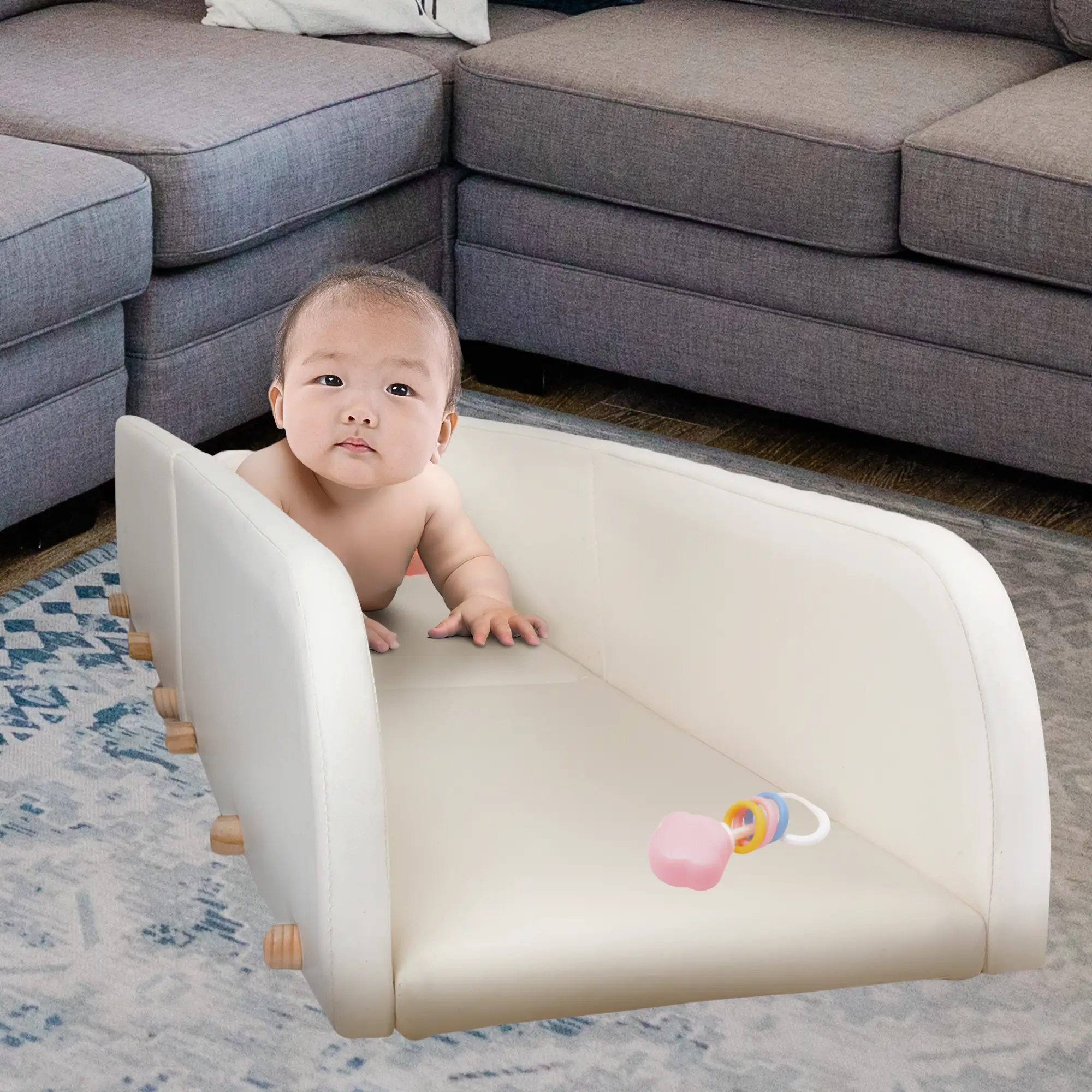
Tummy time is the practice of placing your baby on their stomach while they are awake and supervised. It’s one of the most important early activities for helping your baby build the muscle strength and coordination needed for developmental milestones like rolling, sitting, crawling, and walking.
Even a few minutes of tummy time each day can make a big difference! With consistent practice, a tummy time routine, and the right tools (like Crawlaroo™) tummy time can become an enjoyable, rewarding experience for both baby and parent.
Tummy time helps every baby, but its benefits can vary slightly by age and individual needs. Here’s how tummy time supports development:
Babies at this stage are just beginning to develop head and neck control. Tummy time helps build those early muscles needed to lift and turn the head, eventually supporting rolling, sitting, and crawling. Starting with short sessions on your chest, lap, or another safe, soft tummy time surface can make this new position feel safe and secure.
Even if your baby can roll or sit with support, tummy time remains essential. It helps them practice pushing up on straight arms, which strengthens the chest, arms, and upper back—key for crawling and coordination. Tummy time tools like Crawlaroo™ Infant Crawling Track add a gentle incline and guide baby forward to boost development and keep tummy time challenging.
Torticollis is a condition where tight neck muscles limit head movement. Tummy time encourages babies to turn and look around, which gently stretches these muscles. It pairs well with physical therapy or at-home exercises prescribed by your pediatrician.
Babies who spend too much time on their backs may develop flat spots on the skull. Tummy time is one of the most effective ways to reduce that pressure and help reshape the head. The more time baby spends off their back, the better—and the more comfortable the setup, the more likely they’ll stay engaged.
Babies with developmental delays, muscle tone differences, or medical conditions can greatly benefit from supported tummy time. It helps them build strength, body awareness, and sensory input at their own pace. Always consult your pediatrician or therapist for personalized support, and use tummy time as part of a whole-child approach to early development.
Tummy time gives babies the freedom to explore their bodies, build head control, and begin moving toward important milestones like crawling. But it’s not just about physical development. Tummy time also supports early brain growth, sensory integration, emotional regulation, and visual processing.
| Developmental Area | Benefit of Tummy Time |
|---|---|
| Motor Skills | Builds strength for rolling, crawling, sitting, and walking |
| Neck & Head Control | Supports lifting, turning, and stabilizing the head |
| Brain Development | Encourages cross-lateral movement and neural connectivity |
| Visual Tracking | Improves focus and eye movement coordination |
| Sensory Development | Stimulates touch, proprioception, and vestibular systems |
| Emotional Confidence | Builds resilience and motivation through movement success |
| Crawling Readiness | Prepares muscles and motor patterns for crawling |
As long as baby is full-term and healthy, you can begin tummy time as soon as they come home from the hospital. Start with 1–2 minute sessions, a few times a day, and gradually build up over time.
Tummy time is the best place for your baby to spend their waking hours. Every minute on their belly helps build the foundation for rolling, crawling, sitting, and even early learning skills. The more tummy time you offer throughout the day, the more opportunities your baby has to explore movement, strengthen their muscles, and connect brain and body.
It can be tempting to let your baby enjoy tummy time while you catch up on emails or unload the dishwasher, but tummy time should always be supervised, especially for young babies.
In the early months, babies are still developing head control and upper body strength. During tummy time, there’s a chance your baby may tire quickly, get stuck face-down, or need help repositioning. Staying nearby ensures that your baby remains safe and allows you to respond right away if they show signs of fatigue or frustration.
Timing matters. One of the best ways to help your baby enjoy tummy time is to do it when they’re already feeling calm, content, and alert. Ask yourself: When is my baby happiest? That’s the moment to give it a try.
Many babies feel their best right after a nap or a diaper change, when their basic needs are met and their body is relaxed. This is the sweet spot for tummy time. You’ll likely find that your baby is more tolerant, more engaged, and more likely to lift their head or explore during these windows.
A well-prepared environment helps your baby feel safe, supported, and more in control as they explore new movements. Always use a firm and low surface—never an elevated place baby might roll off of like a bed or couch, or a surface that’s too hard and might hurt baby if they roll or flop.
The Crawlaroo™ is designed specifically for this purpose, offering soft, non-toxic foam and side rails that gently guide and support your baby’s position. This structure helps reduce frustration, encourages forward movement, and keeps your baby centered as they build strength.
Place toys just out of reach during tummy time to encourage your baby to lift their head, reach forward, and shift their weight. Baby-safe mirrors are also great motivators; most babies are fascinated by their own reflection, which encourages visual tracking and head lifting.
This tactic can be especially beneficial for babies who are old enough to start to move forward and begin their journey to learning to crawl. The toy gives them a focused object to move toward. With the addition of Crawlaroo’s bumpers to limit their visual field, they can tap into the focus needed to move forward faster.
One of the most powerful ways to support your baby during tummy time is simply by getting down on the floor at their level.
Sit or lie down facing your baby so they can see your expressions, hear your voice, and feel your encouragement. Talk, sing, make faces, or read a book aloud, holding it at their eye level. These simple interactions not only keep baby engaged, they also stimulate language development, social bonding, and emotional security.
Your presence tells your baby that tummy time is a safe space, not a struggle. When they see you nearby and feel your attention, they’re more likely to lift their head, reach out, and stay in the position longer.
In the early weeks of life—often called the fourth trimester—your baby still craves the warmth, scent, and rhythm of its caretakers body. You are their safe place, and being close to you helps them feel calm and secure. That’s why one of the most soothing ways to begin tummy time is simply lying back and placing your baby tummy-down on your chest.
This position gives your baby the same physical benefits of tummy time, like practicing head lifting and building neck and upper body strength, but in a more comforting environment. Because your chest creates a natural slight incline, it actually makes it easier for baby to lift their head and engage those key muscles, especially in the early weeks when full strength hasn’t developed yet.
While it’s completely normal for babies to fuss during tummy time, it’s important not to force it. Pushing through too much discomfort can lead to a negative association with the position, making your baby resist it more over time.
Instead, keep sessions short, calm, and positive, especially in the early weeks. Stop if your baby becomes overwhelmed, and try again later.
If your baby resists tummy time, start with side-lying play. Place them on their side with a rolled towel behind their back and alternate sides every few minutes.
If your baby favors one side, gently turn their head to the other to stretch both sides of the neck and support even head shape development. Once baby is more comfortable, you can ease back into tummy time.
By around 3 months, aim for 30–60 minutes of tummy time per day, broken into several short, supervised sessions. As your baby grows stronger, you can gradually increase the duration of each session based on their tolerance and engagement.
For optimal development, the goal is to have your baby spend as much of their awake time as possible in a safe, comfortable tummy time position where they can explore.
Babies thrive on routine. From a young age, build a tummy time routine that your baby can look forward to.
Can you do tummy time regularly at the same time of the day? Can you use a consistent positive cue, like a special tummy time song or familiar tummy time mat (like Crawlaroo™) to help your baby associate tummy time with fun?
You can also try offering baby’s favorite toy, a gentle massage or back rub, or whatever will create positive associations for your little one.
Tummy time works best when your baby feels safe and secure. Loud siblings, curious pets, or unpredictable household noise can make babies feel unsettled or overstimulated. Set up a quiet space—and consider using a playpen or gated area to keep the space calm and controlled.
Crawlaroo™ infant crawling track adds to this sense of safety with soft bumpers that create gentle boundaries, helping your baby stay centered and focused. When the environment feels secure, babies are more likely to relax, explore, and enjoy tummy time.
Too much time in swings, bouncers, or infant seats can actually slow motor development by limiting your baby’s ability (and motivation) to practice essential skills. Why would baby want to do the hard work of developing their muscles when passive positioning gear can prop them upright, where they can look at the world around them?
While these toys/devices might seem convenient, they keep your baby in a passive, reclined position—and some have even been proven unsafe for extended use. Or involved in safety recalls due to accidents.
Instead of relying on positioning gear, prioritize active, supervised play on the floor. Bonus: you don’t need to buy all those expensive, gimmicky toys. What they want and need is actually super simple.
Many parents wonder if they’re doing tummy time correctly.
Here are signs you’re on track:
Success doesn’t mean zero fussing. Babies often show their displeasure about tummy time because it is challenging! Especially at first. With consistency and time, tummy time will turn into their favorite way to spend time.
Some babies take longer to meet milestones, and that’s okay! But if your baby isn’t lifting their head by 3 months, struggles to tolerate tummy time at all, or seems unusually floppy or stiff, it’s a good idea to talk to your pediatrician. Early intervention can make a big difference in supporting your baby’s development.
Tummy time can help you spot early signs of a delay. Babies who avoid weight-bearing on their arms, show uneven rolling, or have limited head or limb movement may benefit from professional evaluation. Physical or occupational therapy can offer tailored strategies to help your baby catch up.
Crawlaroo™ can be a helpful tool for special needs and delayed babies who need extra support. Still, always follow professional medical guidance when developmental concerns arise.
You can begin tummy time as soon as you get home from the hospital, as long as your baby is full-term and healthy. At first, a few minutes a couple of times a day is enough, especially if it’s done on your chest or across your lap. This helps build comfort and connection before moving to the floor or tools like an Infant Crawling Track.
Once your baby is crawling well and spending lots of time on their belly independently (typically around 6–7 months), structured tummy time becomes less necessary. However, it still supports continued core and upper body strength, so floor play in this position is still beneficial well into toddlerhood.
Tummy time strengthens the neck, shoulders, arms, and core—all of the essential muscles for crawling. It also helps babies learn how to shift weight, push with their arms, and coordinate their movements.
Crawlaroo™ supports this by providing a subtle incline and stable but soft crawling track surface that encourages forward motion and gives babies an early sense of success.
We are fans of Montessori-style infant toys that stimulate baby through interesting textures and gentle sounds. Mirrors are also a hit, as babies love looking at faces, especially their own! High-contrast black and white images work well for newborns, while older babies may enjoy reaching for sensory toys.
Crawlaroo™ makes toy placement more motivating by keeping toys in your baby’s visual range while removing outside distractions from their field of vision.
This is totally normal in the early weeks, and every baby develops at a different pace. Simply lying on their belly provides valuable sensory input and gently stretches the muscles needed for head control.
If your baby is not attempting to lift or turn their head at all by around 3 months, seems unusually floppy or stiff, or shows very little movement, it’s a good idea to check in with your pediatrician. Early support can make a big difference.
Yes! You just may need to approach it differently. Start small and choose times when your baby is well-rested and content. Don’t push past their limits. If baby gets fussy, pick them up, soothe them, and try again later. Consistency and responsiveness are more important than duration.
Create a calm, clutter-free space and always use a firm, flat surface—soft or squishy spots like beds or pillows can actually make tummy time harder and less safe. Babies feel more confident when they’re well-supported and stable.
Avoid doing tummy time right after feeding, since a full belly can make baby feel gassy or cause spit-up. Instead, choose a moment when your baby is content like after a nap or diaper change. Use a soft lovey or favorite toy nearby to help them feel secure. Get down on their level, make eye contact, talk gently, or sing.
Yes, this often means your baby is developing strength and coordination. As they lift their head and turn to look around, they may lose balance and roll out of position. This is a natural part of learning how to move and eventually roll on purpose.
If it happens over and over, try a slight incline or a more supportive surface like your chest or the Crawlaroo™. Gently guide them back onto their belly and continue playing and encouraging them.
Yes, tummy time helps distribute pressure and encourages babies to turn and use both sides of their body. If your baby tends to favor one cheek, gently rotate their head to the other side during tummy time. Side-lying play and upright babywearing can also help.
Absolutely! The goal is to help your baby spend as much time as possible in a safe, active tummy time position throughout the day. Whatever tools help make that happen—comfortably and consistently—are a win.
Just be sure to rotate positions to keep things balanced: chest-to-chest, lap time, floor play, and infant development tools like Crawlaroo™ all offer unique benefits. While some pillows can limit arm movement or cause baby to “get stuck,” Crawlaroo™ encourages forward motion with support, making tummy time more rewarding and less frustrating.