Are you questioning whether bouncers are bad for development? Do you fear you rely on your bouncer, activity gym, or baby swing too much and use it too often? Are you building your baby registry and searching for the best baby bouncer options? This article is for you!
We aren’t here to guilt you, shame you, or tell you to never use these assistive devices. They can be a real lifesaver when you just need two hands for a few minutes!
We’ll break down the top myths and facts about bouncers and similar devices, what they CAN and CAN’T do for infant development, and how to use them in a safer, more intentional way. We’ll also share easy alternatives that often work even better when you need to keep baby entertained for a few minutes.
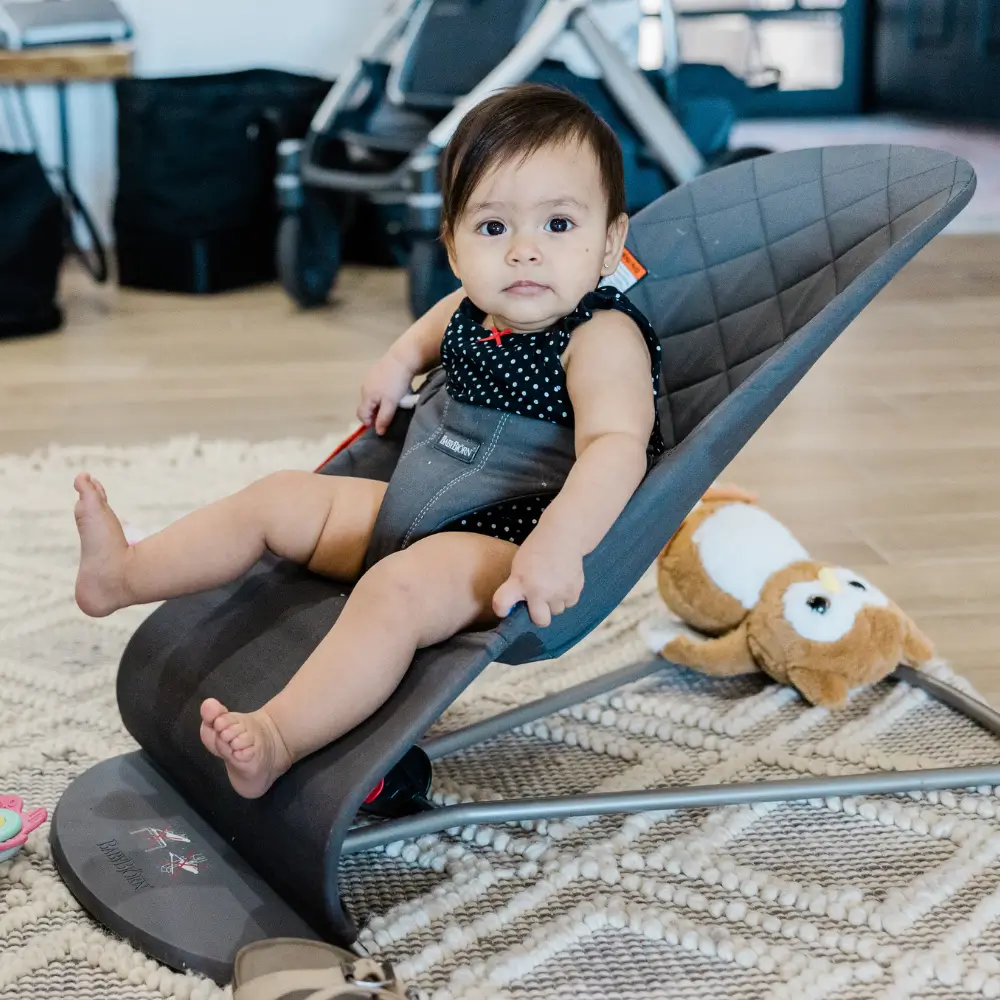
When we say “baby bouncer,” we are referencing a whole category of container-style baby equipment including:
Fact: Some devices can look like they are helping your baby build strength, but jumper-style products often trigger reflexive pushing rather than true strength and coordination. Over time, these devices can encourage patterns like toe-pointing and repeated extension, while limiting the variety of movement babies need for rolling, pivoting, crawling, and balanced core development. The most meaningful strength for crawling and walking comes from varied, self-initiated movement like tummy time, reaching, rolling, rocking, and floor exploration.
Fact: Floor time tends to get easier when it becomes familiar. When babies get consistent, daily time on a firm surface, many become more content there because they can move, explore, and feel in control. A predictable setup helps: a simple mat, a few toys, and an uncluttered space. A structured floor play option like Crawlaroo® can also make this easier by creating a defined “movement zone” that supports tummy time and early crawling practice without placing baby in a fixed sitting position.
Fact: Families have real needs, and sometimes we need two hands for a few minutes. In moderation, containers can serve a purpose as short, supervised breaks, especially when you choose a product that fits baby’s stage and supports comfortable alignment. The goal is balance: equipment for brief moments, and plenty of time for active, on-the-floor play opportunities the rest of the day.
Fact: Safety depends on the product, how it’s set up, and how it gets used. Equipment should be used only as intended, with secure straps when applicable, and with an adult close by. It’s important to stay alert to the reality that baby products do get recalled, so it’s smart to check the CPSC recall database for a specific model. And because babies can drift off unexpectedly, it helps to remember that many loungers, inclined or cushioned products are not designed for sleep.
Fact: Hip positioning matters most in the early months because hips still form and stabilize. Pediatric PTs often recommend a supported “M” or “frog-like” leg position (knees higher than bottom, thighs supported) rather than long periods with legs forced straighter, especially in the first 6 months.
Fact: These devices may entertain your little, but they can encourage a “tiptoe” posture where baby pushes through the balls of the feet instead of placing the whole foot down. Over time, repeated practice in that position can make toe-pointing feel normal and can tighten the calves, which may make it harder for baby to find a stable, flat-footed stance on the floor. A little toe-pointing is common as babies experiment with standing and bouncing, but we don’t want to exacerbate it with too much time in devices.
Fact: A trusted brand can reduce certain risks through better safety testing and smart design, but it can’t change how a baby’s body is meant to develop. Even high-end bouncers, swings, and activity centers can limit natural movement and practice time for rolling, sitting, and crawling.
How do you know if it’s ok to use that fun baby equipment you got at the baby shower? Is it safe? Is it good for your baby? How do you weigh the pros and cons so you know you’re doing what’s right for your child?
It can be helpful to ask yourself these 4 questions:
What need is this piece of baby gear fulfilling? If the goal is a short, supervised place for baby to enjoy while we do something that isn’t safe to do while holding them (like making dinner or taking a quick shower), equipment can meet a real need.
If the goal is to help baby work on reaching developmental milestones and crawl sooner, it’s always best to build skills through free movement on the floor, where baby can roll, reach, pivot, rock, and explore.
The “how” matters as much as the “what.” It helps to review alignment, readiness, and use case for each device you plan to use:
Many accidents that happen in bouncers and similar equipment are preventable and due to user error. Make sure to familiarize yourself with usage guidelines for each device you own. Also make sure your partner, babysitters, and older siblings are aware of how to safely use each device!
How long will you use the device? How will you keep track of time spent in the device? And is everyone in your household on the same page and ready to communicate estimated daily usage? Problems arise when time in containers adds up to long stretches throughout the day, not when we are using assistive devices briefly.
A simple, parent-friendly way to think about it:
Lastly, we recommend that you ALWAYS register your devices so that you get notified of important safety recalls. Even the most trusted brands sometimes issue recalls of infant devices, and the only for-sure way to stay informed is by registering your products.
If you have a device that’s second-hand or don’t wish to register your product, you can visit the Consumer Product Safety Commission website to search for recalls.
If you want a developmentally appropriate, safe, and convenient alternative to container-type devices, you have plenty of options!
A Crawling Track like Crawlaroo®: Crawlaroo® gives baby a dedicated crawling zone with soft, protective foam and built-in bumpers that help keep them safe and focused on the toys in front of them. Plus a grippy surface that makes pushing, scooting, and forward movement feel more rewarding. Unlike containers that hold baby in place, Crawlaroo® supports tummy time and active floor play. It’s designed to help babies practice crawling sooner, which can jump-start the cross-body coordination that supports early brain development.
A simple floor-time station: A firm mat or blanket on the floor with 3–5 rotating toys (high-contrast cards, crinkle book, rattle) gives baby freedom to move while keeping setup easy.
Playpen or gated “yes space”: A secure area that blocks pets, siblings, and hazards lets baby play independently without being held in a fixed position. This allows you to relax a bit or finish a few to-do’s while baby enjoys independent play.
Activity gym (on the floor): Overhead toys encourage reaching, kicking, rolling, and longer stretches of engaged play.
Tummy time pillow: A rolled towel or tummy time pillow can make early tummy time feel more doable while baby builds strength. Many tummy time pillows also include bright colors and shapes, or even incorporate engaging toys.
Ball Pit: Older babies that can sit on their own LOVE to play with balls! A ball pit with soft foam sides can keep them entertained for quite a while. Bonus: older siblings also enjoy ball pits and will happily join baby.
The safest way to choose the “right age” is to look at the product’s label first, then double-check it against your baby’s skills, because babies hit milestones at different times. You can also ask your pediatrician for individualized guidance before you start using a device.
Follow the product’s age/weight/height label first, then double-check it against your baby’s skills, especially head and trunk control. A device can meet the label and still be a poor fit if baby slumps, leans, or can’t stay aligned.
There isn’t one perfect number for every baby, but pediatric guidance generally encourages limiting time in gear that restricts movement and prioritizing floor time instead. A helpful rule: if device time starts replacing tummy time and free play most days, it’s probably too much.
If your baby spends long stretches in seats, swings, or loungers, floor time often feels harder and shorter because it’s less familiar. If your baby ISN’T spending MOST of their time playing on the floor, practicing tummy time, getting cuddles from you, or being worn in a sling or carrier, it’s worth thinking about how they can get more time out of container devices. Bouncers, seats, exersaucers, etc. should be used in short bursts only.
It’s possible. Less floor time means fewer reps to build strength and coordination, but many babies crawl later (or skip crawling) for totally normal reasons. If your baby also isn’t rolling, pushing up, pivoting, or using both sides evenly, it’s worth discussing with your pediatrician or a pediatric PT/OT.
Stop when baby exceeds any posted limit (weight/height/age) or starts trying to climb out, tip it, or twist into awkward positions. You should also consider scaling back if you notice persistent toe-pointing, slumping, or one-sided posture while using it.
Start small and build up, aiming for multiple short tummy-time sessions every day while baby is awake and supervised. Many pediatric resources suggest working toward roughly 15–30 total minutes a day by around 2 months, then continuing to increase as baby tolerates more.
Check the U.S. Consumer Product Safety Commission (CPSC) recall database and search your product’s brand and model name. Register your product with the manufacturer too, since brands often email registered owners if a recall happens.