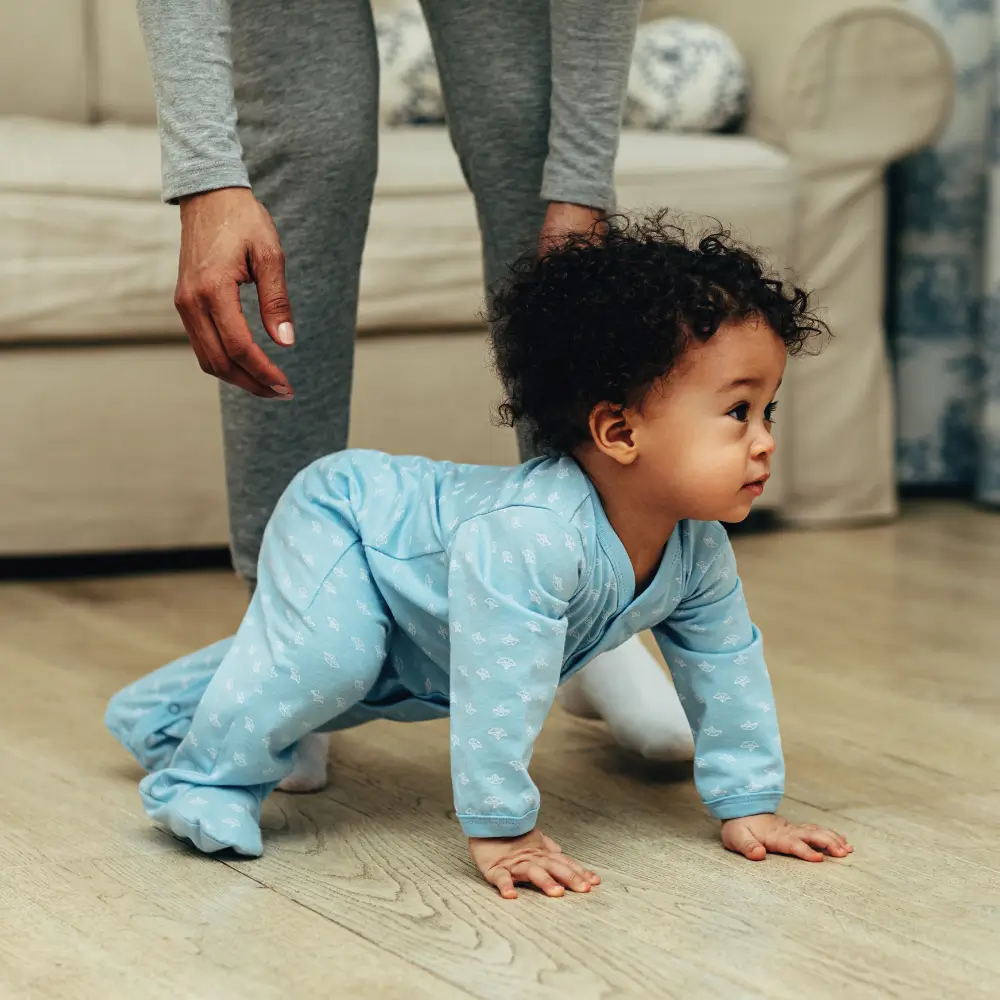
There’s nothing quite like watching your baby take off crawling for the first time. It’s one of the most exciting early milestones! That’s why most parents want to help baby crawl sooner.
Crawling lays the foundation for coordination, strength, and brain development, but not all babies get there on the same timeline. In this post, you’ll learn when babies typically start crawling, why your baby might NOT be crawling yet, and discover 10 simple activities you can do at home to help your baby build strength, confidence, and mobility sooner.
Most babies begin crawling between 6 and 10 months of age, though some start as early as 5 months or as late as 11 months.
It’s important to remember that babies develop at their own pace, and crawling isn’t a strict requirement for healthy development. That said, encouraging crawling helps build the muscular strength and bilateral coordination that support walking, writing, and even reading later on.
Crawling rarely starts as smooth, hands-and-knees crawling. Progress looks like pushing up, pivoting in circles, rocking, scooting backward, or doing a “half crawl” with one knee down. Those are all normal stepping stones.
It’s natural as a parent to worry that your baby is behind schedule, especially if other children their age are progressing more quickly. But every baby is unique! Even if your baby is delayed, there are many interventions that can help them get back on track.
Aside from giving your baby a sense of independence and autonomy, crawling is the start of many important cognitive and emotional developments.
Crawling activates nearly every major muscle group, especially the core, shoulders, and hips. It helps your baby develop the strength to:
Cross-crawling teaches the left and right sides of the brain to work together, supporting:
As babies crawl, they improve:
Crawling exposes babies to varied textures (carpet, grass, wood), enhancing:
If I could pick one habit that helps crawling more than anything else, it’s consistent tummy time. Tummy time strengthens the neck, shoulders, arms, back, and core so your baby can lift their head, push up, and eventually shift weight forward to move.
Healthy, full-term babies can start tummy time as early as your first days home. Begin with 1–2 minutes at a time, 2–5 times a day, and build gradually. By around 3 months, many babies work toward a total of 30–60 minutes per day split into short sessions.
Rocking is one of the clearest “almost crawling” signs. It builds shoulder stability, hip strength, and balance, and it teaches your baby how to shift weight between arms and legs. When you see your baby push up onto hands and knees, help them practice rocking gently forward and back.
You can stabilize their hips with your hands so they don’t slide into a split or collapse. Keep it playful! Sing a short song with a familiar rhythm or count each of their rocks out loud. Aim for short practice bursts, even 10–20 seconds at a time, then let them rest. Rocking often turns into a first forward “lurch,” and then crawling.
Crawling is hard on surfaces that slip, sink, or feel unstable. Babies do best on firm, flat, non-slip surfaces where hands and knees can grip and push. Consistency matters for babies. When you set up the same safe crawling spot daily, your baby learns, “This is where I move my body.” That predictability builds confidence. A cushioned but firm surface also protects sensitive knees and hands and can make longer practice sessions more comfortable.
Crawlaroo is the first Doman Crawling Track available in the United States. It blends the comfort and safety of a play mat with the challenge and focus benefits of a tunnel. Our infant crawling track has soft side walls that limit distractions in baby’s side vision and guide baby gently forward.
You can safely elevate the back to give young babies a downward slope or elevate the front to challenge older babies to move forward at a slight incline. It’s truly the best developmental tool for helping your baby crawl sooner. Check it out here.
Babies crawl because they want something. Use that motivation. Put a favorite toy just beyond reach so your baby has to stretch, shift weight, and attempt a small movement to get it. Start close enough that they can succeed with a small effort. If it’s too far, they’ll get frustrated and give up.
Rotate the toy’s position: slightly to the right, then the left. This encourages turning the head, shifting weight, and using both sides of the body. For babies practicing hands-and-knees movement, try placing the toy at eye level on a low cushion or a sturdy surface so they must push up and look up. When they reach the toy, let them play with it so they are rewarded immediately.
Babies learn through imitation and connection. Get down on the floor face-to-face so your baby can see your eyes, read your expression, and hear your voice clearly. Smile, talk to them, and narrate what’s happening in simple, encouraging language like “You’re pushing up!” or “I see you reaching!” Your calm presence helps your baby stay regulated, which makes movement easier.
Then turn it into a connection-based game. Crawl a short distance away, pause, and invite them toward you with open arms, eye contact, and gentle praise. Clap softly, celebrate tiny efforts, and repeat in short bursts so your baby stays interested and doesn’t get overwhelmed.
Older siblings can be powerful “crawl coaches” because babies love to copy them! The key is to keep sibling-led crawling lessons calm, predictable, and safe.
Start by giving your older child one simple job, like sitting a few feet in front of baby and showing a favorite toy, rolling a soft ball slowly, or calling baby’s name in a gentle voice. Ask them to stay low and still, and remind them that loud cheering, sudden grabbing, or crawling too close can startle baby and make tummy time feel stressful.
Create a protected practice zone so everyone knows the boundaries. Adding a playpen, baby gate, or Crawlaroo® to your setup helps keep baby centered and prevents helping from turning into crowding and roughhousing.
Adding slight elevation under the chest helps baby push up and use their arms during tummy time. This can help your child feel a bit less frustrated, especially if they are very young and new to tummy time.
Roll a small towel and place it under the upper chest (not the belly), then bring the elbows slightly under the shoulders. This gives your baby a better base to lift their head and start bearing weight through the arms—the first step toward crawling!
Some babies want to crawl but can’t hold their body up long enough to coordinate the movement. You can help by supporting their midsection while they’re on hands and knees. Place one hand under the belly or hips to take a little weight off, then let hands and knees stay planted.
This allows you to teach the pattern of crawling to give them a “leg up” when they’ve developed the strength to do it on their own. Encourage one small reach forward, then reset. Even a few seconds of successful all-fours time builds confidence and strengthens the right muscles. As your baby gets stronger, lighten your support until they hold the position independently.
Bonus: babies usually think this is super fun!
Play gear is fun and can be stimulating for your baby, but experts agree it should be limited, especially for young babies who are not able to sit unassisted.
Swings, bouncers, loungers, and activity seats may make life easier, but they also keep babies in passive positions where they don’t work their core, shoulders, or hips. When babies spend too much time contained, they get fewer chances to practice rolling, pushing up, rocking, and crawling.
Aim to make the floor and tummy time your baby’s main source of exercise, where they spend much of their free time. Use gear when you truly need it, but balance it with multiple daily floor sessions. If you’re trying to help crawling happen sooner, this shift often makes the biggest difference.
Mirrors are one of the best crawling motivators because babies love faces, including their own. Place a baby-safe mirror on the floor during tummy time or all-fours practice. Many babies lift their head longer and reach more when a mirror is involved.
Tunnels encourage forward movement. You can use a soft play tunnel or make a simple one with a blanket over sturdy chairs. Keep it wide, low, and safe. Put a favorite toy or your face at the other end. Start with short distances so baby can succeed quickly, then gradually increase the challenge.
Helping your baby learn to crawl sooner doesn’t require an intense training routine. Your baby WANTS to move! If you give them lots of supervised tummy time and floor play each day and offer plenty of positive enforcement, crawling will come!
To give your baby an extra developmental boost, consider an infant crawling track! It’s especially beneficial if you suspect your baby may have a crawling delay and you want to jumpstart their progress. Please make sure to check out our Crawlaroo FAQ’s for more info and don’t hesitate to reach out to us if you have any questions!